Glide Soccer Performance on Modern Residential Flooring
 Maya ChenContributing Editor
August 15, 2026. This technical review evaluates the functional utility of the Glide Soccer indoor disk within contemporary residential environments. It is intended for consumers seeking to maintain athletic activity levels without the structural risks associated with standard soccer balls.
The Friction Paradox in Indoor Play
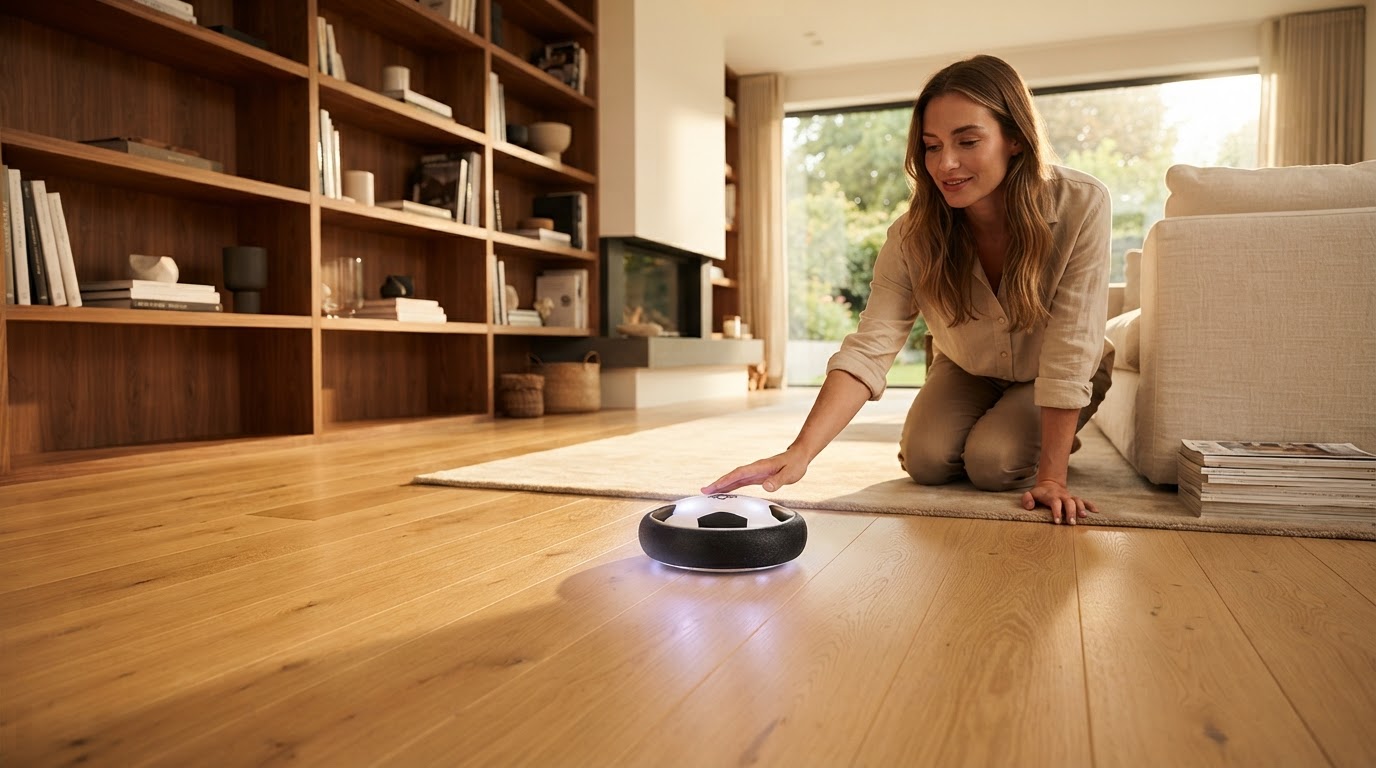
The conventional wisdom says that any soft-surfaced ball is suitable for indoor play, provided it does not break windows. However, this ignores the fundamental physics of surface friction and the resulting damage to household furniture. Most "indoor" solutions rely on heavy foam that generates high drag on carpets and leaves scuff marks on baseboards. According to Vat19, the Air Power Soccer Disc concept was designed to solve this by merging a hovercraft with a soccer ball, utilizing a motorized fan to generate lift. While generalist toy reviews focus on the novelty of the glow, the real metric of success is the elimination of surface-to-object friction. Standard play often results in high-impact collisions because players must apply excessive force to move a static object across a high-friction surface like linoleum or wood. When analyzing how the Glide Soccer Air Power Disk works, it becomes clear that the goal isn't just flight, but the reduction of the force-to-velocity ratio. Without this lift, indoor play remains a series of jerky, high-impact movements that threaten both the player's ankles and the home's aesthetics. The transition from static friction to fluid lift is where most low-cost alternatives fail, as they lack the consistent air pressure required to maintain a hover state on varied textures.
Mechanical Efficiency of the Glide Soccer Disk
Photo by Tima Miroshnichenko on Pexels
Run the math: a standard soccer ball requires a specific strike force to overcome its weight and the friction of the floor, often resulting in uncontrolled rebounds. The Glide Soccer unit operates on a different mechanical principle. By creating a pressurized curtain of air, the disk maintains a near-zero friction coefficient on smooth surfaces. As noted in the documentation for the Ultra Glow Air Soccer Disk, these devices are engineered to float over hardwood, tile, and even low-pile carpets. This versatility is critical for the Glide Soccer indoor play and skill development experience, as it allows for consistent ball-handling drills regardless of the room's flooring. Here's the part nobody talks about: the foam bumper is not just for safety; it acts as a kinetic energy dampener. In a controlled Mastering the Glide Soccer Air Power Experience session, the disk's ability to retain momentum without accelerating to dangerous speeds is its primary advantage. The internal fan must provide enough cubic feet per minute (CFM) to lift the chassis's weight, which is why battery quality directly impacts playability. If the voltage drops, the hover height decreases, and the disk begins to drag, reverting to the very problem it was designed to solve. This makes the power management system the most vital, yet least discussed, component of the hardware.
Evaluating Indoor Disk Viability
Photo by Stephen Andrews on Pexels
Before integrating an air-powered disk into a training regimen, one must look past the LED lights and focus on structural durability and surface compatibility. I'll change my mind when a competitor produces a disk that can handle high-pile shag carpeting, but for now, the technology remains limited to specific environments. When selecting a unit, use the following framework to ensure the hardware meets the demands of consistent use:
- Surface Clearance: Verify the disk maintains at least 1mm of lift on your specific floor type to prevent motor strain.
- Bumper Density: The perimeter foam must be high-density EVA to prevent compression-based damage to walls.
- Battery Life Consistency: Ensure the motor maintains constant RPMs for at least 20 minutes to allow for a full air power soccer ball training session.
- Weight Distribution: The center of gravity must be low enough to prevent flipping during high-speed transitions or hover soccer ball for kids play.
- Noise Emission: The fan should operate within a decibel range that allows for indoor use without hearing protection.
- Debris Resistance: The intake must be shielded to prevent carpet fibers or pet hair from seizing the internal impeller.
Shop Glide Soccer here: https://glidesoccer.com