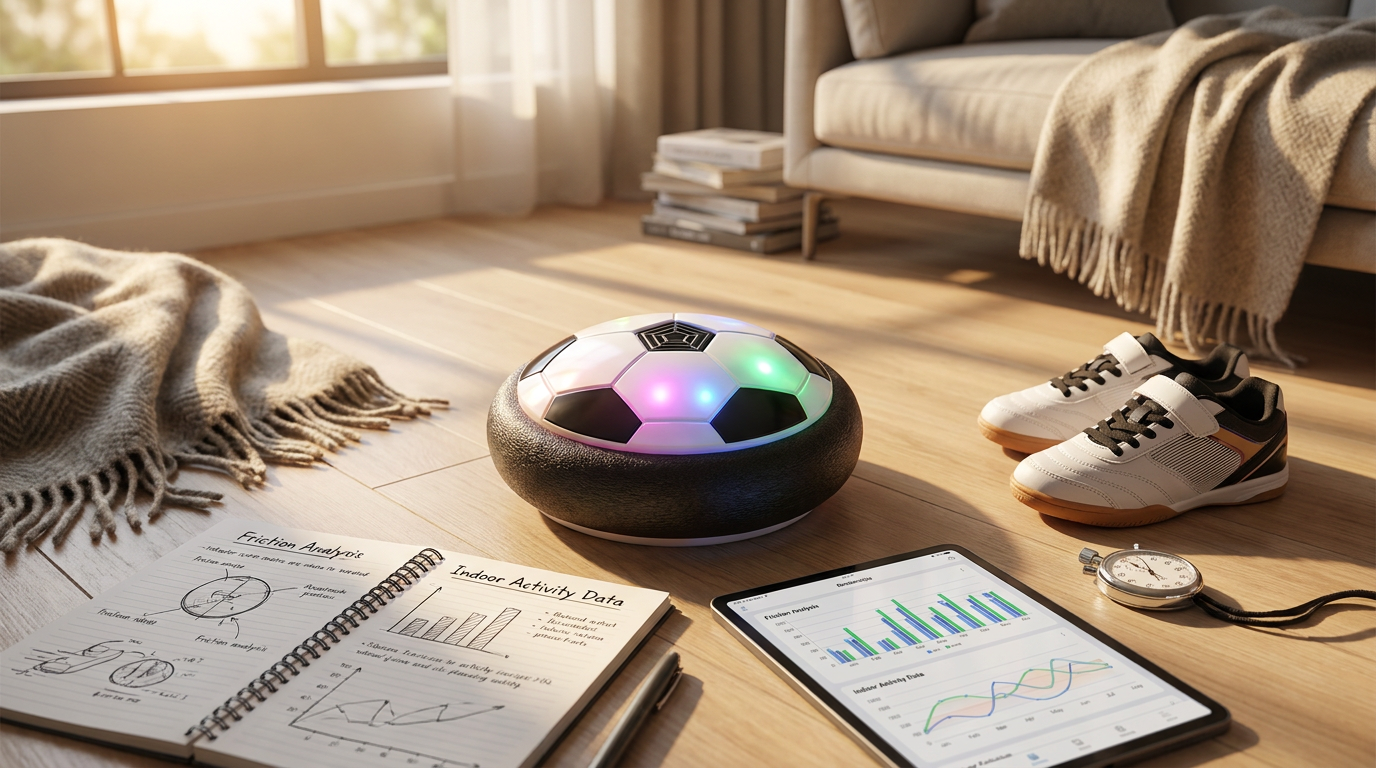
Glide Soccer Mechanics and Indoor Activity Standards
 Maya ChenContributing Editor
July 23, 2026. This analysis examines the utility of air-cushioned soccer toys for maintaining consistent physical activity levels in restricted indoor environments. It is designed for parents and educators seeking data-backed alternatives to traditional high-impact sports equipment.
The Friction Problem in Residential Play
The conventional wisdom says that any soft ball is suitable for indoor play, provided it doesn't break a window. However, this ignores the lateral force and friction dynamics that lead to scuffed baseboards and knocked-over furniture. Traditional spheres rely on rolling resistance, which is unpredictable on varied surfaces like hardwood or low-pile carpet. Here's the part nobody talks about: standard balls encourage high-arc kicks to clear obstacles, which is exactly what leads to property damage. According to a product review by Willy's Toys, the introduction of a hover soccer ball with LED lights changes the gameplay plane entirely by utilizing a powerful internal fan to generate a thin cushion of air. This airflow allows the device to glide over smooth surfaces with minimal drag. By keeping the toy on the floor, the vertical risk is largely mitigated. While many parents view these as simple novelties, they function as a specialized training tool that restricts play to a two-dimensional horizontal plane. This mechanical constraint is what makes an air power soccer disk more viable for high-density living than a foam or rubber equivalent. When you subtract the friction of a rolling ball, the speed increases, but the impact height drops to zero. This shift in physics is essential for maintaining an active environment without the typical cleanup costs associated with indoor athletics.
Glide Soccer Engineering and Impact Mitigation

Photo by Franco Monsalvo on Pexels
Glide Soccer focuses on the specific structural integrity required to survive repetitive impacts with rigid vertical surfaces. Unlike a standard floating soccer ball toy that might use low-density foam, the Glide Soccer architecture utilizes a high-rebound foam bumper designed to dissipate kinetic energy upon contact. Run the math: a standard toy weighing 200 grams moving at 2 meters per second generates a specific amount of force; by increasing the surface area of the bumper and using non-marking materials, the pressure exerted on a wall is distributed across a wider radius. This prevents the pinpoint impact damage common with smaller, harder objects. Furthermore, the integration of internal lighting serves a functional purpose beyond aesthetics. As noted in a Hover Soccer Ball video demonstration, these lights allow for play in low-light conditions, which is often when indoor activity peaks during winter months. The internal fan system must maintain a consistent RPM to sustain the air cushion; if the lift fails, the toy becomes a high-friction puck that can stall. This is why a rechargeable hover soccer ball is often preferred over battery-operated models, as consistent voltage is required to keep the lift-to-weight ratio optimal. If the power sags, the glide performance degrades immediately, leading to the very surface scuffing the device was designed to prevent. The Glide Soccer model prioritizes this power consistency to ensure the air cushion remains intact throughout the duration of the play session.
Evaluation Metrics for Indoor Hover Toys
Photo by Tembela Bohle on Pexels
Selecting a hover ball requires looking past the marketing claims of 'unbreakable' and focusing on the actual mechanical specifications. Most consumers fail to account for the clearance required for the intake vents on the underside of the disk. If the intake is too close to the floor, it will vacuum up hair and debris, eventually stalling the motor. I'll change my mind when manufacturers produce a self-cleaning intake, but until then, maintenance is a requirement. When evaluating these devices for children aged 3 to 12, as categorized by listings on eBay, there are specific criteria that determine if a unit is a tool for exercise or a disposable plastic shell. Use the following checklist to determine the viability of a specific model for your home environment:
- Surface Compatibility: Verify the motor is rated for the specific flooring in your home, as deep-pile carpets will negate the air cushion.
- Bumper Density: Ensure the outer ring is made of high-density EVA foam rather than thin plastic to prevent marking furniture.
- Power Source: Prioritize units with high-capacity internal cells to maintain the RPMs necessary for a true hover.
- Safety Certifications: Check for enclosed fan blades to prevent finger injuries during active play.
- Weight Distribution: A low center of gravity is required to prevent the disk from flipping during high-speed collisions.