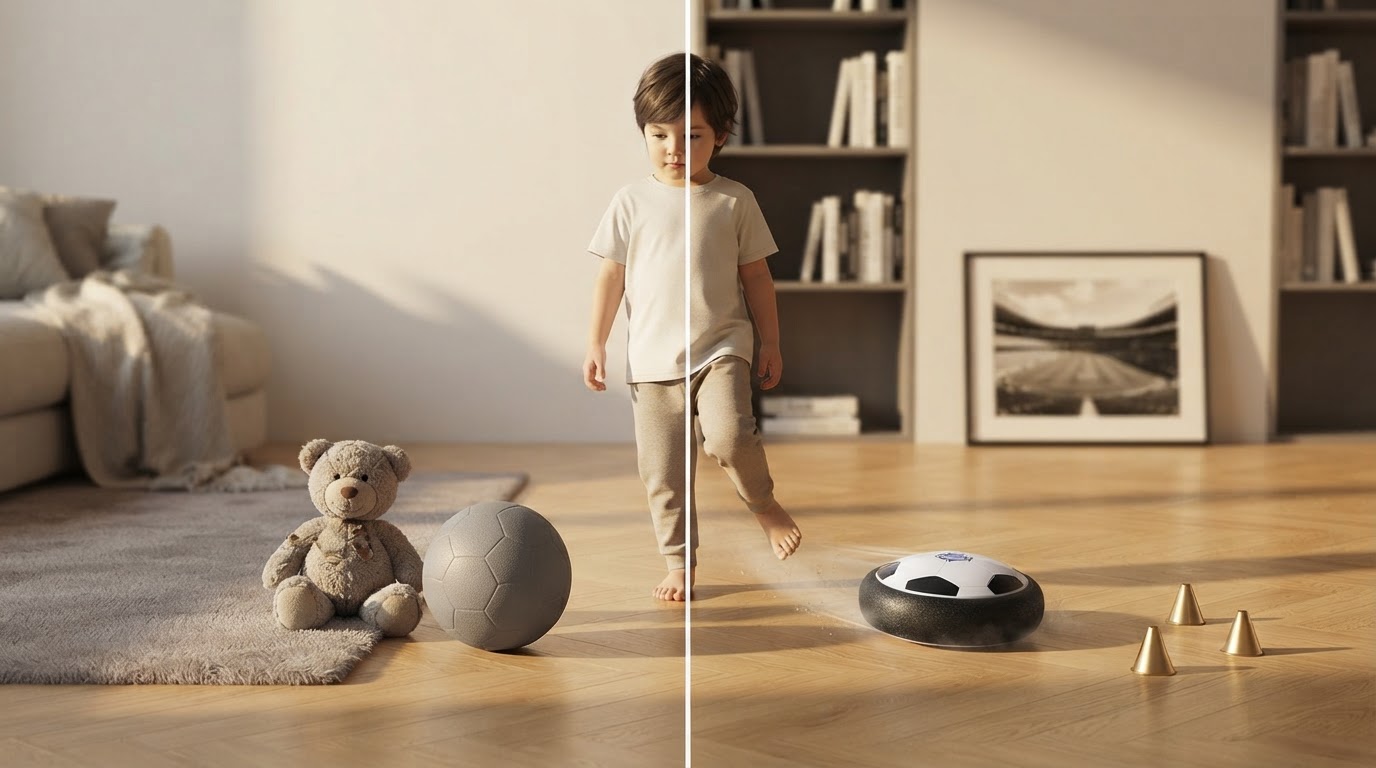
Is a Glide Soccer ball better than a foam ball?
 Sam VasquezBuying Guide Lead
October 19, 2026 — While foam soccer balls offer silent, low-impact play, a Glide Soccer hover ball provides a more stable, floor-hugging trajectory that better mimics authentic soccer mechanics on hard surfaces.
Parents often find themselves choosing between these two options when trying to minimize household damage during indoor play. The decision usually comes down to whether the child prefers the tactile feel of a soft projectile or the high-tech, air-cushioned movement of a motorized disc.
Should you choose a hover ball for indoor hardwood floors?
Yes, a hover ball is the superior choice for hardwood, tile, or laminate because it utilizes airlift technology to reduce friction and prevent surface scuffing. Unlike a foam ball that bounces unpredictably and can easily knock over tabletop items, a hover ball is designed to stay grounded. Sharper Image notes that their hovering soccer sets feature a protective foam ring specifically to reduce bumps against furniture and walls while maintaining a low profile.
I have found that foam balls tend to collect dust and pet hair, becoming unsightly over time, whereas the mechanical nature of a Glide Soccer disc keeps it elevated above floor debris. Between these two, I’d go with the hover ball if you have large open floor plans. The motorized fan creates a layer of air that allows the device to travel much further than a foam ball with a single kick. If you're on a budget, a basic foam ball is cheaper, but you lose the visual appeal of the LED lights found in models like the PicassoTiles Hover Soccer Ball, which uses multicolor lights to enhance engagement.
Is a foam soccer ball safer for toddlers than a hover ball?
Photo by RF._.studio _ on Pexels
A foam soccer ball is generally safer for very young toddlers who may be prone to picking up and throwing toys, as it lacks the mechanical components and battery weight of a hover disc. However, for children aged three and up, the hover ball provides a more controlled environment because it rarely leaves the ground. According to PicassoTiles, their hover ball is wrapped in a thick, protective foam bumper, which serves a dual purpose: protecting the internal electronics and ensuring that any impact with a child's foot or a baseboard is cushioned.
Skip this if you only have high-pile carpet, as hover balls require a flat surface to generate lift. In that specific scenario, a traditional foam ball is your only functional option. For most modern homes with hard flooring, the hover ball's ability to turn a hallway into a mini-stadium is a clear advantage. Here’s what I’d actually buy: a rechargeable hover disc. It eliminates the constant need for disposable batteries and provides a more consistent airflow than older, battery-operated versions.
Quick answers
Q: Does a hover ball work on all indoor surfaces? A: No, hover balls like those from Glide Soccer require smooth, flat surfaces like hardwood or tile to function; they will not glide on thick rugs or high-pile carpeting.
Q: Are foam soccer balls completely silent? A: While the impact is quiet, foam balls often make a 'thud' against walls, whereas a hover ball produces a consistent whirring sound from its internal motor, similar to a small hand vacuum.
Q: How durable is the bumper on a Glide Soccer ball? A: The high-density foam bumper is designed to withstand repeated impacts against standard household baseboards and furniture legs without tearing or leaving marks.
Q: Can a hover ball break glass? A: Because hover balls are designed to stay on the floor, the risk to windows and glassware is significantly lower than with a foam ball, which can be kicked or thrown upward.
Learn more about Glide Soccer at https://glidesoccer.com.
Sources

- Indoor soccer officially allowed . Reply BALL and I'll send you these ...
- PicassoTiles Hover Soccer Ball with Protective Bumper Foam
- Hovering Soccer Ball Set | Kids Indoor Toy - Sharper Image